Lorewind & World Building
Hey There!
As I mentioned at the top of my last post I have decided to actually USE and update MY website. I have added my blog to my website, you may even be reading it on there already!
You can see my older blog posts on my Ko-fi page here!
I’ll be posting on my blog about once a month.
There will be more updates on my website as time goes on and as I familiarize myself with the tool set. I am paying way too much for my website to JUST be an art portfolio so I am gonna have some fun with it.
I’ve added a “Cool People” page on my site. These are links to other artists and creatives that I know and think are cool. I’ll be adding more folks on there as time goes on and only with their permission.
Now for some Lorewind updates.
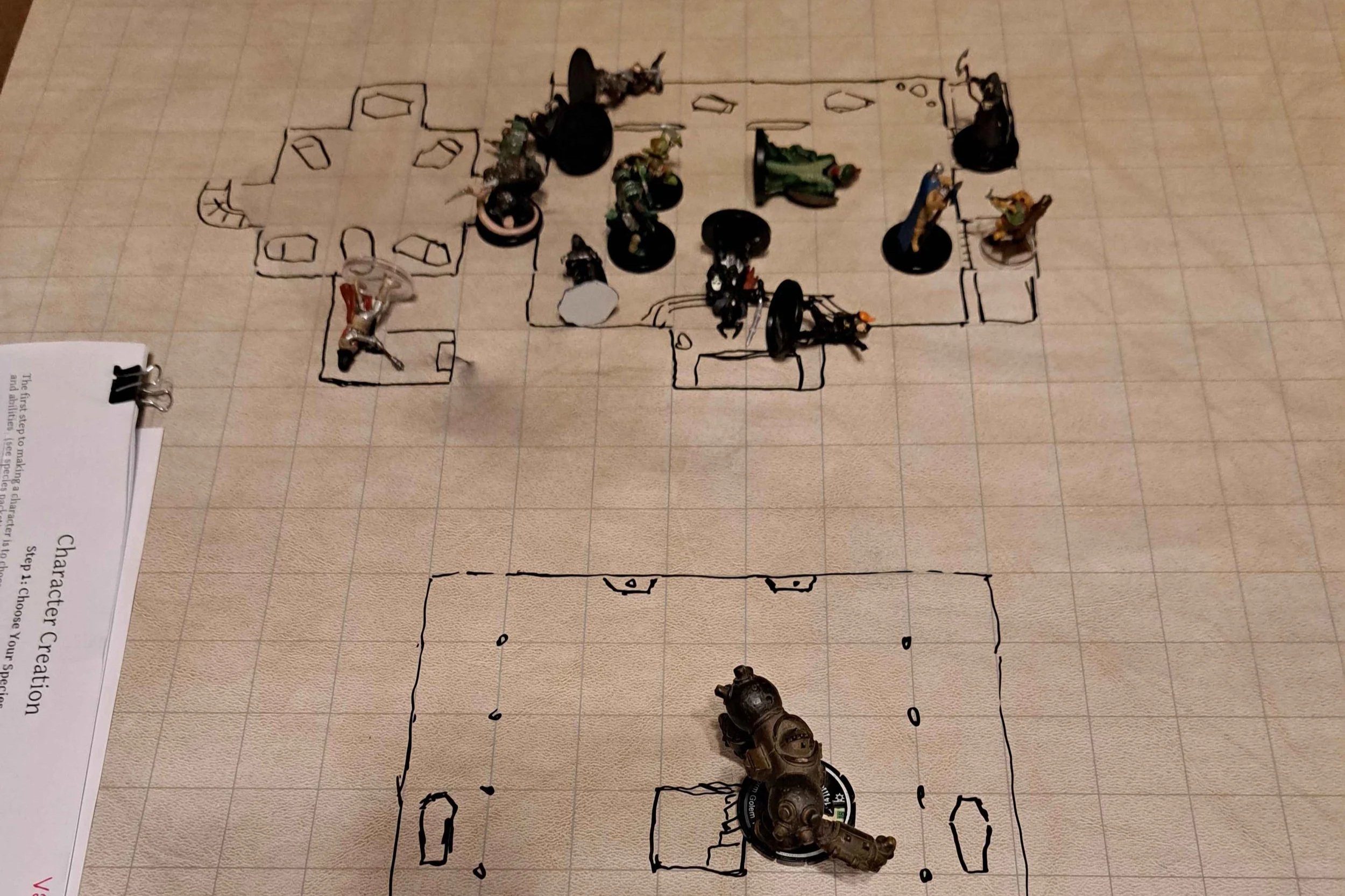
A photo from the last play-test session. Combat was quick and violent, exactly what I was aiming for.
There has been a lot of progress on my TTRPG Lorewind over this last month. I’ve been adding new mechanics and refining those that seemed a bit rough during the last play-test.
This version (.42) if the game is now formatted to a booklet/zine style with a better flow of information.
An example of one of those changes is on the pages detailing each attribute now have their connect skills listed WITH them on the page. Not having them listed together slowed down character creation as players had to flipped between two completely different sections of the then packet to see which skills were connected to which attribute.
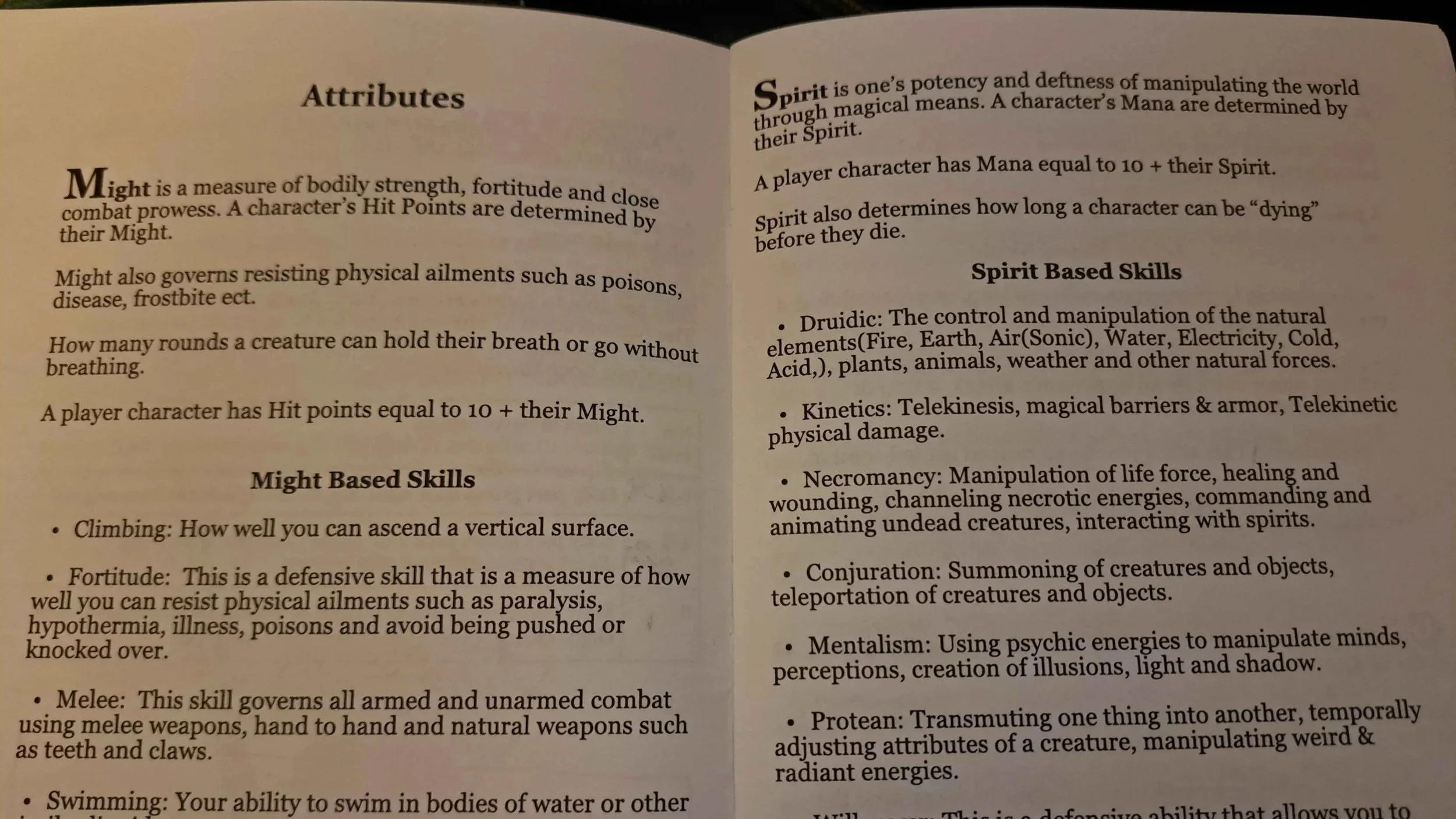
A photo of the booklet test print.
The facing pages of the booklet also mean that more information can be presented to the player at one time. Also, let’s be real my original “vision” for this game was to have it be formatted as a zine booklet so this just “feels” better to me.
Along with the new formatting I have also been making more artwork for Lorewind. After some deliberation and input from my partners I’ve decided I am going to stick with largely traditional media for the game’s artwork. Pens, ink, pencils, brushes and gauche are currently what have been using to make the artwork. I think I am starting to get the hang of it and finding my workflow. Currently I’m working on cover art and some more interior illustrations.
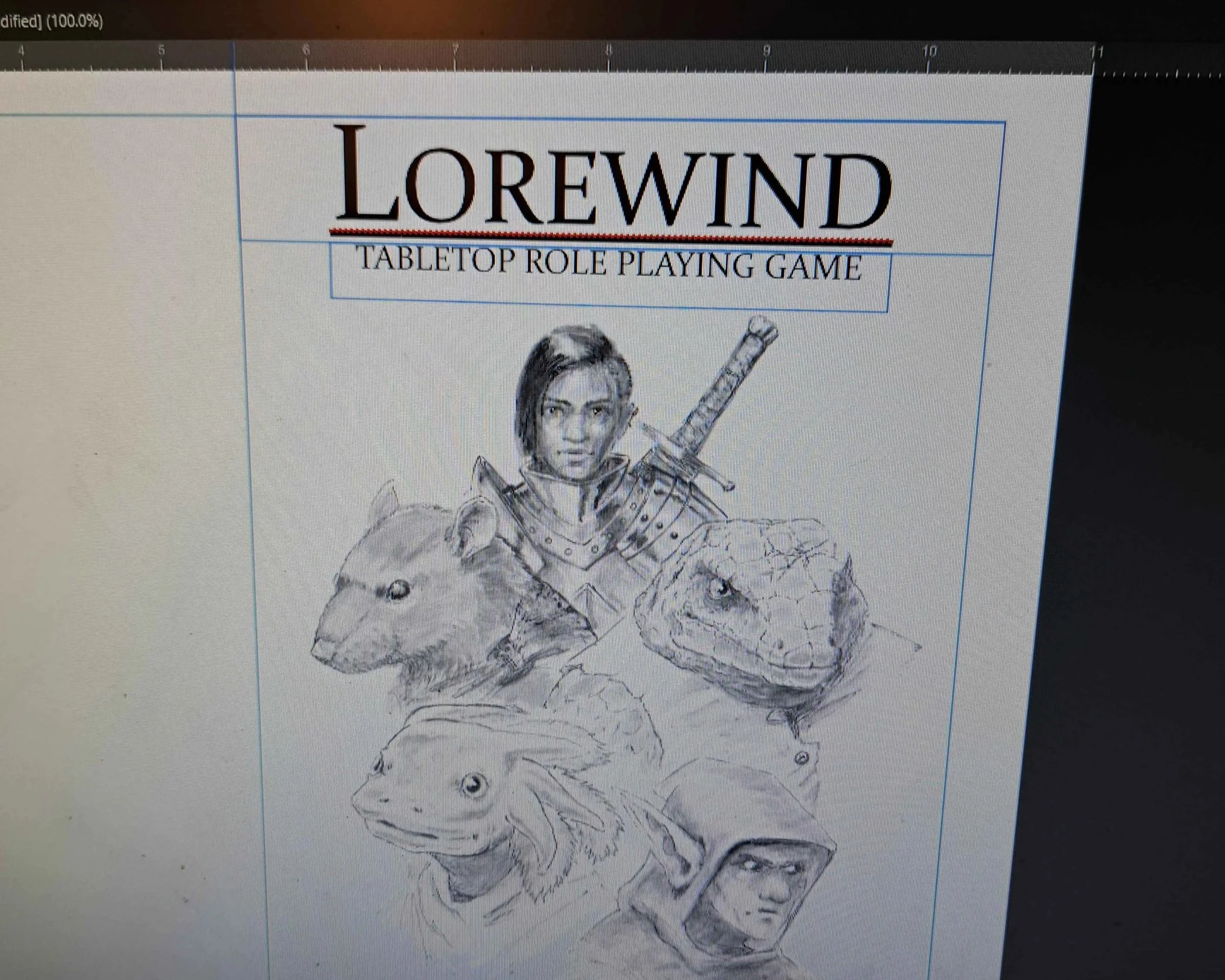
A work in progress of the zine cover for version .42 of Lorewind.
My intention for the next play-test (TBD) is to have this booklet finished and hand each player a copy. This iteration of the game isn’t the final version of the game but it is a step in that direction. My goals remain the same:
It needs to be quick to make a character and get playing.
It needs to be simple to run and easy to explain.
The rules need to be lite, at least compared to games like Pathfinder & D&D. I’ll call it “rules medium”
The game will be “high trust” between players and the Game Master. (GM)
The game needs to be fun.
So far, I’ve hit all of these milestones, but I want to keep refining it as rough edges show up. There is a little more depth I’d like to have in the rules but not so much that it gets confusing or overly complicated.
I used Affinity Publisher to set to the document. I followed a tutorial by Anto of Icarus Games, do check his channel out. His video series on working with Affinity Publisher was a big help to me!
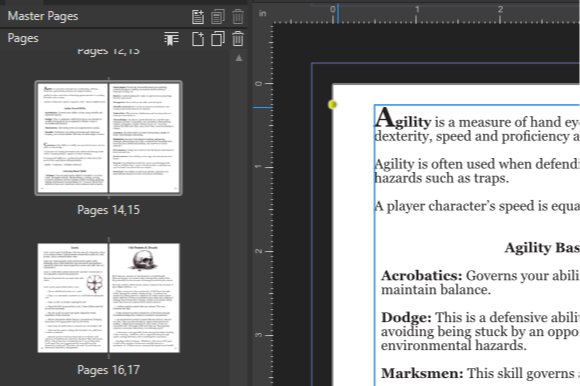
A screenshot of me working in Affinity Publisher.
I am not much of graphic designer and it has been a loooong while since I successfully set up a zine format document without some serious hand holding. So there was some trial and error. The first few attempts at printing did not go well, haha. The booklet is 8.5in x 11in paper folded in half and double sided I needed my page count to be divisible by 8 for the pagination to work correctly. Uuhhh…. I didn’t know about that at first and I was super confused when the test print came out all crazy.
I did eventually figure out.
The friction of failure is a good thing.
I’m not likely to forget how to do this in the future because I had to do the work of figuring it out the “hard way”. It’s easy to forget that failure is a part of learning. The world we live in (at least in the US) failure is stigmatize and it’s something we are trained to fear. I think this fear of failure keeps us from trying new things, learning new skills and leads some people to take shortcuts to avoid it (This isn’t not about AI).
Anyway, that friction while I was trying to paginate was a great reminder to me that failure is important and can be a good thing when it comes to learning something new. And hey, after all that, I do have a test print of the booklet in my hands and that feels fucking great.
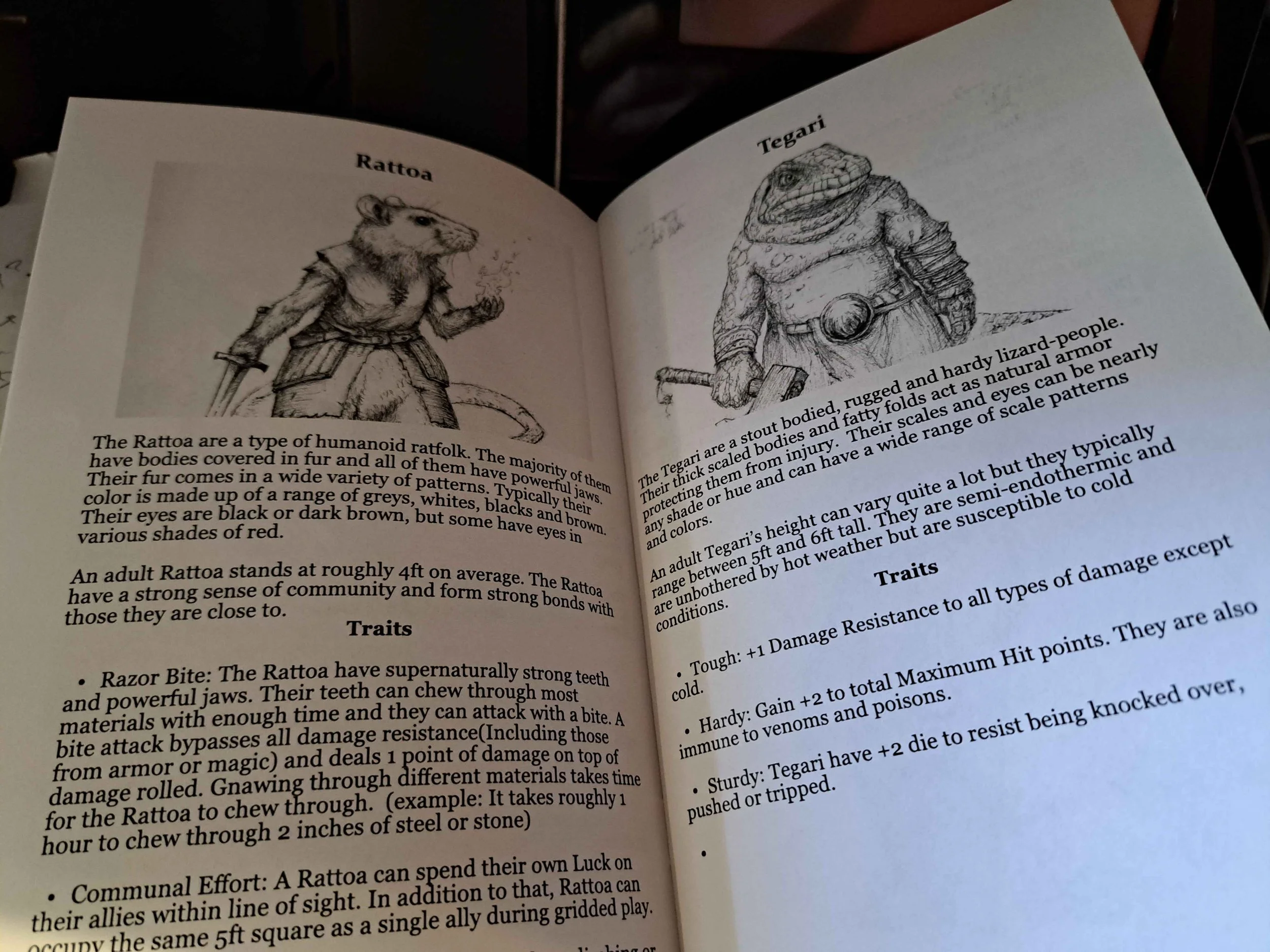
The booklet test print in my fucking hands.
Changes from the last play-test include: adding in a sneak attack system, more depth to the weapon types, adjustments to the human traits, more details to the magic system, very simple rules to govern combat maneuvers, an update to the intro lore and a clearer overview of the basic mechanics for players.
I’ve got a long list of things to work on for Lorewind before I can really say it’s “finished”, at least enough for me to set it down for a little while. There are milestones I want to hit with it, but the big one is to hand the system over to someone else to run without any help from me.
That step is a ways off.
For now I am just focusing on the step that is in front of me. Getting version .42 ready to be in my players hands and running the next play-test.
My awesome friend, Jodie, asked me to write a bit about how I’ve been going about world building for this project.
I have been starting with some broad strokes.
Making some basic decisions about the world the setting takes place on.
The world is called Theia and has similar qualities to earth (breathable air, earth-like gravity, plants animals ect.). The world as one moon that looks like a menacing eyeball. All of the playable species are refugees from another dying world and the original people who used to inhabit Theia all mysteriously vanish hundreds of years ago leaving behind countless ruins and relics.
The details come in when I start writing adventures in this setting.
The player characters are a part of a small, three month old settlement built in the ruins of the one of lost people of Theia. Cool! Now it’s time to start answer questions.
What’s their settlement called? New Haven.
What are these people eating? The young of a giant, seemingly feral domesticated, isopod that they calling an “Oxopod”, fruits and small animals.
Were they able to bring supplies from their old world? Yes, but not much. Some tools, clothes, weapons and maybe some food from the old world.
What did the lost people of Theia look like? The ones in this region looked like slender four-armed humanoid figures with pointed ears.
Did they leave art behind depicting themselves? Yes, paintings, relief carvings, pottery and marble statues.
I pretty much start answering these questions as I write. I’ll also get idea when I am at work or in the shower. I try to write those down as quickly as possible, sometimes even on a piece of paper towel if I am in a hurry.
What’s the adventure? The group are tasked to search for their lost friend and fellow villager.
What do they encounter on the way there? What animals do they see? Are they dangerous? Oh, shit! They are large terror birds that can mimic the sound of their prey? YIKES!
That is actually what I ended up using during the last couple of play-tests.
None of this stuff springs fully formed from my head. I need to keep layering details and thinking about how these creatures, places, factions characters fit into the world and interact as I go.
The key thing for me is, I start with some broad strokes and then go super small. One settlement, a few people and some wildlife, then I build from there.
This is the same process of world building I used for my primary D&D3.5/Pathfinder campaign setting called Noth. Within a couple weeks from now that setting will officially be 20 years old. At this point Noth is a massive multi-continent sprawling world filled with long histories ( heavily influenced by player actions), factions, countless NPCs, cities and nations. BUT, it all started with an island called Talonfell, a coastal cave filled with kobolds and a single small fishing village.
Anway, this is getting a bit long so I am gonna wrap it up.
If you made it this far, you’re awesome!
Thanks for reading <3
See ya next month!
-Alec (Onyx Rat)